
01
EXPERTISE, NOT JUST EQUIPMENT
Machines arrive.
Know-how doesn’t.
Specifications travel easily. The judgement behind them must be taught to the local team.
WHAT IT TAKES Turn expert knowledge into teachable material
TLI CONNECT · TECHNOLOGY TRANSLATION
We turn the tacit know-how of your senior experts into structured, teachable training materials.
Every lesson is built around real on-the-job scenarios — so learners truly understand, and cultural and language gaps across borders shrink.
Start with one critical task. We map the knowledge, design the learning path, and set measurable time-to-competency targets.
Built for HR, L&D and operations leaders scaling expertise across borders

FROM TACIT KNOW-HOW TO TEAM CAPABILITY
Structured. Taught.Delivered.
Technology Translation is
what TLI has always done.
TLI AT A GLANCE







01 / THE TRANSFER GAP
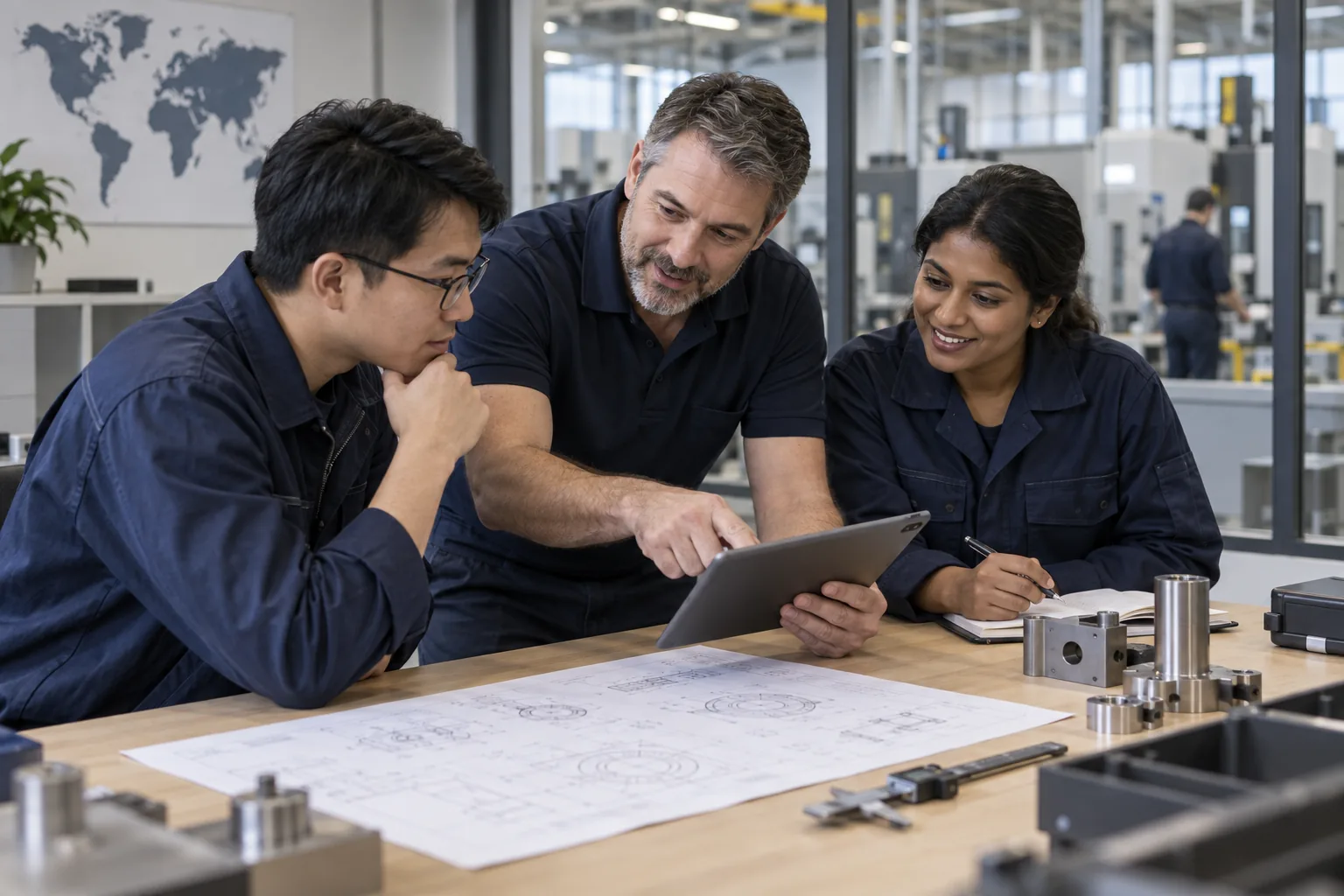
Relocating an operation moves equipment in weeks.
Expertise takes considerably longer.
EXPERTISE, NOT JUST EQUIPMENT
Specifications travel easily. The judgement behind them must be taught to the local team.
SHARED WORDS, DIFFERENT MEANING
Teams may agree in a meeting yet differ on decisions, feedback and responsibility when work begins.
DOCUMENTED IS NOT EXECUTED
A translated procedure works only when people understand how to use it on the job.
02 / THE CORE CAPABILITY
Technology Translation
Not converting technical documents from one language into another. Making the technology itself understandable, usable, teachable and — finally — executable by the people who have to run it.
It is how TLI extends language training into global workforce development, and into the transfer of technical knowledge between markets.
Four stages every technology has to pass through before it is genuinely in use.
Define the key terms and concepts in the language your team uses.
Practice them in real tasks, from design reviews to shift handovers.
Equip internal instructors to pass the knowledge to the next team.
Enable the local team to run the process without headquarters watching over it.
The deliverable is capability, not coverage. A finished glossary proves very little. People who can do the work in another market prove everything.
IN PRACTICE · NVIDIA CUDA
“We cannot translate everything because it doesn’t make sense — the library is too big. AI can help some of it, but we have to identify some of the key CUDA languages.”
Rather than translating an entire library, TLI isolates the terminology a working engineer genuinely needs.
Each term is given a defined, consistent rendering — the same discipline TLI applied when it compiled dictionaries decades ago.
Terminology becomes structured curriculum, so the technology can be taught rather than merely referenced.
THE AIM
“We’re empowering the students so that the students can teach CUDA in Chinese.”
Jason Ho · President & CEO, Taipei Language Institute
Have a task your new site needs to perform?
Talk to a training expert ↗IN THEIR WORDS
Two accounts from a 2024 Business Weekly report
on how TLI builds its courses.
QUOTED DIRECTLY
“What I learn in Chinese should relate to my work. If a teacher says, today let’s study economic development in Africa, I think: that is a very interesting topic, but it has nothing to do with my job right now.”
REPORTED BY THE JOURNALIST
TLI matched him with the instructor best suited to him — close to him in age, with a comparable experience of living abroad — so their conversations connected and learning felt easier.
Both accounts come from Business Weekly issue 1886, 30 July 2024. Laflamme is quoted directly; the Belmans passage is the reporter’s summary of his account, not his own words.
03 / THE WHOLE WORKFORCE
Every level needs the language ability
their own tasks require — no more, no less.
WHITE COLLAR
Technical specialists, managers and R&D teams working across sites. Design reviews, specification discussions, technical documentation and coordination with headquarters.
FRONTLINE
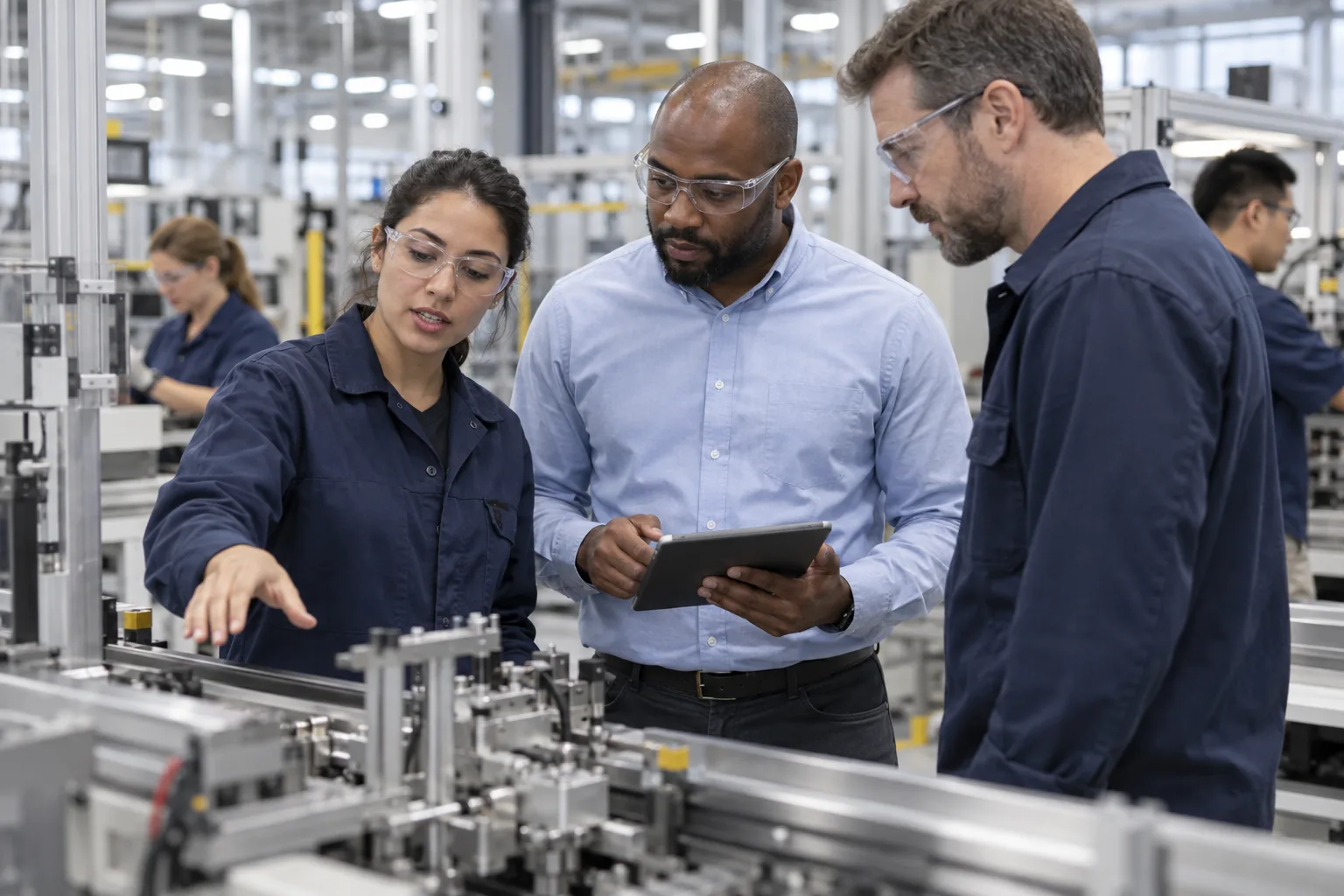
The people running the equipment. What they need is narrow, specific and safety-critical — the words attached to the task, learned to the point of reflex.
AT SCALE
When global talent shortages force rapid recruitment, large cohorts need working communication fast. TLI has delivered Chinese and Taiwanese courses for migrant workers with the Taipei City Department of Labor.
SEMICONDUCTOR LANGUAGE MOBILITY SYSTEM
Developed for semiconductor clients, applicable wherever precision and compliance matter.
Task-driven learning, with skills mapped directly to roles and risk profiles.
Training tied to real work artifacts: SOPs, CAPAs, SPC charts and shift logs.
One unified global framework, with localized content packs for each site.
Potential measures: time to independent work, task errors and handoff accuracy.
IP protection, export controls and privacy considered by design.
04 / INTERCULTURAL PROTOCOLS
“Every organization has its own language, and every cross-cultural environment develops its own culture.”
Jason Ho · President & CEO, TLI
TLI works alongside HR and L&D teams to make unspoken expectations explicit, then to structure them into intercultural protocols that let different groups genuinely work together.
Over time the objective is independence: a cross-cultural training architecture the company runs itself, rather than a course it keeps buying.
TSMC Intercultural Learning Framework
05 / CAPABILITY THAT STAYS
TLI’s deepest capability is making knowledge teachable. Since 1956 the work has been defining terminology, writing materials, training instructors and adapting lessons to how learners actually encounter a language.
That same capability can be handed over. We develop your internal instructors so your specialists’ knowledge becomes structured, repeatable learning that continues after the programme ends.

More than 80,000 instructors trained worldwide, each certified through 150+ hours. Six defined teaching ranks set a clear scope of learners and subject matter, and a tagged instructor database matches teachers to a learner’s field, background and goals.
TLI recruits instructors from industry — former foreign-bank executives, ex-foreign-ministry staff, chiefs of staff to listed-company chairs — then trains them to teach. They understand what their learners are being asked to do.
A three-teacher rotation exposes learners to several specialisms instead of one voice. Observers sample group and individual classes. Senior and newer teachers co-plan, so standards transfer between them.
06 / ACROSS INDUSTRIES
Technology Translation began in advanced manufacturing.
The problem is not confined to it.
Wherever an organisation moves expertise into an unfamiliar market — a new plant, a new subsidiary, an acquired team — the same gap opens between what the company knows and what its people on the ground can actually do. TLI’s clients span the industries below.
07 / INSTITUTIONAL BACKING
Knowledge transfer between markets
works better with institutions behind it.
2025 · GLOBAL ALLIANCE
TLI and the Purdue Research Foundation signed a Global Alliance Memorandum of Understanding at the TLI-PRF Global Alliance Forum in Taipei, committing to global talent development, educational innovation and closer U.S.–Taiwan ties. TLI CEO Jason Ho and PRF CEO Chad Pittman signed, witnessed by former U.S. Vice President Mike Pence, who delivered the keynote address.
“Our combined expertise will create transformative opportunities in semiconductors, advanced manufacturing, and renewable energy.”
Chad Pittman · President & CEO, Purdue Research Foundation
60+ YEARS · U.S. GOVERNMENT
Agreement with the U.S. Department of State and AIT: Mandarin and Min-Nan training for diplomats and military advisors.
Work extended to the U.S. Embassy in Beijing.
Collaboration with the Foreign Service Institute, which adopted TLI textbooks and pedagogy.
University partnerships include Harvard, Yale, the University of Pennsylvania, Stanford–IUP, the University of Delhi and the University of Hawai‘i.
DATA FINDS THE GAP. LANGUAGE CLOSES IT.
“Data helps us understand the customer, and language helps us build connection.” The starting point has not changed since 1956: “We continue to work on language first. Language is the core.”
Talk to a training expert ↗08 / HOW TO BEGIN
No curriculum or technical files needed for the first conversation.
Here is how a training project takes shape.
YOU START
Tell us the task, location and people involved in the short form below.
WE DISCUSS
We clarify the roles, language needs and current baseline with you.
YOU REVIEW
Review the training approach, success measures and quote before deciding.
AFTER AGREEMENT
Once agreed, training starts and we measure progress together.
Ready to describe one task?Talk to a training expert ↗
MEASURE THE CHANGE
We establish a baseline with your team, select measures tied to the work, then review the same measures after rollout. Targets depend on the role, site and available data.
LET'S CONNECT
Tell us what your people have to be able to do.
We’ll help you work back to the training that gets them there.
↗ Identify the tasks your people must perform in another language
↗ Map terminology, scenarios and risk to the right training format
↗ Discuss instructor development so the capability stays in-house
A CONVERSATION ABOUT YOUR TRANSFER
Share your work email and a few details. TLI can then discuss your roles, tasks and a suitable training and measurement plan with you.
TLI can follow up by email to discuss the roles, tasks and measures that matter to your team, then outline a suitable training plan.
Have something to add? Email us ↗GOOD TO KNOW
Not to begin. We can start from role descriptions, task lists and the kinds of documents involved. Where deeper material is needed, scope, IP protection and export-control considerations are agreed before anything is shared.
Yes. TLI has delivered large-scale, short-runway language programmes, including Chinese and Taiwanese courses for migrant workers commissioned by the Taipei City Department of Labor. Tell us the headcount, site and timeline.
That is often the goal. TLI trains internal instructors so your own specialists’ knowledge becomes teachable, which lets programmes continue without us. Several clients have gone on to systematize their own frameworks.
Adapting materials to context is central to how TLI works. Share typical reviews, handovers or management situations, and we’ll discuss suitable content and the scope of customization.
They depend on participant numbers, proficiency, goals, delivery format and customization. After your inquiry we can discuss arrangements and a quotation. This page does not offer fixed packages or prices.